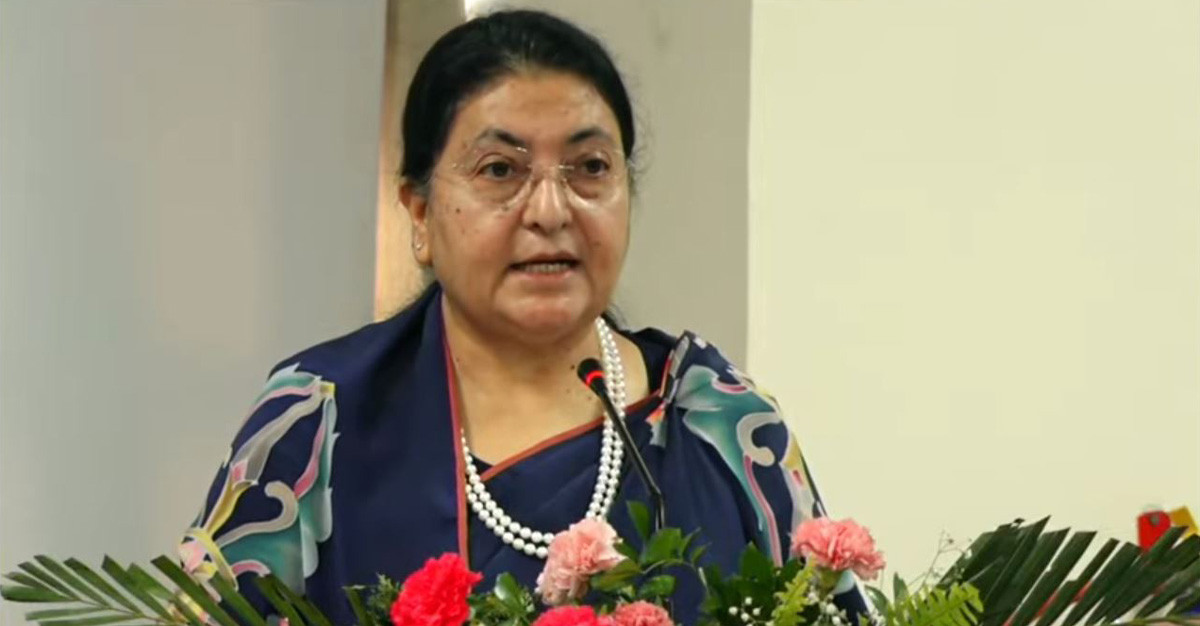
Kathmandu. When a person who has already reached great social and political heights begins to nurture further ambitions and desires, no one can predict when, where, or how time might take them. If it were otherwise, Bidya Devi Bhandari—Nepal’s first female president and the only one to hold the position for two consecutive terms—would have dismissed her intense desire to re-enter mainstream politics at the very first thought.
History shows how difficult it is to rise from being “Honourable” (mananiya) to “Right Honourable” (sammananiya). The pain of never achieving that title can be best explained by none other than senior leader of CPN (Unified Socialist), Jhalanath Khanal—husband of Madan Bhandari’s competitor—who despite becoming party chairman twice during the communist movement, never had the chance to become head of state.
Bhandari, originally from Bhojpur, entered politics at the age of 18 during the 1979 student movement. Her husband, Madan Bhandari, was one of the chief communist ideologues of Nepal and the architect of the People’s Multi-Party Democracy (PMPD/Janata ko Bahudaliya Janabad). Through this thought, he gave the communist movement in Nepal a new definition—advancing it through democratic means.
After Madan’s mysterious death in a jeep accident in 1993, Bidya Devi entered active politics, using her family’s political legacy and struggle to establish herself as a woman leader. On that basis, she was elected a Member of Parliament twice (1994 and 1999), a proportional representative in the Constituent Assembly (2008 and 2013), and became the first female Defence Minister.
Following the establishment of the republic, Nepal promulgated its constitution on October 20, 2015 (Asoj 3, 2072 BS). Shortly afterward, on October 29, Bhandari was elected as Nepal’s first female president, and in 2018, she secured a second term. From 2015 to 2022, her nearly seven years in the presidency owed as much to her own contribution as to the political backing of then CPN-UML Chairman KP Sharma Oli and internal party power struggles.
As president, Bhandari earned both praise and criticism. She institutionalized women’s leadership and represented Nepal internationally as head of state. However, she became controversial for siding with her party (CPN-UML) during parliamentary dissolution disputes, where her role was seen as partisan rather than constructive. Political analysts often argue that her role could not rise above party loyalty.
Meanwhile, Oli had been consolidating his grip within the party since 2013, experimenting politically—from forging alliances (with the Maoist Centre in 2017), to unifying the parties in 2018, to later witnessing their split due to ideological and operational differences. His dramatic political maneuvers seemed more like a movie plot than routine politics.
These dynamics forced even the once-mighty Nepali Congress to ally with CPN (Maoist Centre), CPN (Unified Socialist), and others to survive against Oli’s rise. Despite being cornered, Oli’s party still emerged as the largest by proportional votes in the 2022 federal election, proving his enduring influence. Yet, from 2018 to 2021, despite reaching the height of power, Oli faced mounting challenges: citizens’ rising expectations, rapid technological change, weak governance, and declining trust.
Some of Oli’s rivals and disgruntled leaders, tired of his sarcasm and governance failures, concluded that he could no longer run the party. They turned to 65-year-old former president Bhandari, who had been quietly living in Budhanilkantha, believing that she might be the alternative. Reports predicting Oli’s eventual defeat in 2027 (2084 BS) elections further encouraged Bhandari to step forward—a decision increasingly seen as politically dangerous.
On June 28 (Madan Jayanti), she announced her re-entry into active politics. But since then, instead of receiving recognition, she faced humiliation—even her party membership renewal remained uncertain.
Before formally returning to politics, Bhandari had even traveled to China, perhaps seeking external leverage. Yet she failed to secure even functional unity among Nepal’s leftist forces—including the Maoists and UML. As a result, she stumbled at the very first step, politically bogged down like someone slipping in the mid-monsoon mud of July–August. Her inclination toward Chyasal (a UML faction) over the party mainstream has hurt the self-respect of UML members.
While establishing the office for Madan Bhandari’s 75th birth anniversary, she could not even bring Shankar Pokharel—the UML’s General Secretary, interpreter of People’s Multi-Party Democracy, and a rising leader with both national and international recognition. Failing to align with Pokharel meant losing a timely chance to position him as Oli’s successor and uphold Madan Bhandari’s ideological legacy within the party.
Like former US President Jimmy Carter, she could have established a “Madan Bhandari Foundation” or “Bidya Bhandari Center,” promoting Nepal’s culture and tourism worldwide while retaining moral authority. Instead, her political gamble risks bringing irreparable damage to UML as well as the country.
Bhandari’s bold step to contest Oli’s leadership could have created new political balance. But current circumstances—party structure, timing, and public sentiment—tilt heavily toward risk rather than opportunity. More than for herself, this journey appears dangerous for her party and Nepal’s democratic practice.
As the ancient political economist Chanakya once said: “When a person who has already held the highest office returns to active politics, it only breeds jealousy, conspiracy, conflict, and instability. Such a person should rather serve as a guide, advisor, or mentor for society.”
Ultimately, ignoring the tragic downfall of Rashtriya Swatantra Party (led by Resham Chaudhary and Ranjita Shrestha) due to infighting, and forgetting her own history, contribution, and responsibility, Bhandari’s desire to re-enter active politics—encouraged by a handful of opportunistic leaders from UML and other parties with unstable characters—may well turn out to be her greatest blunder.